Balthazar van den Bossche (1681–1715) was a distinguished Flemish painter active during the late Baroque period. Born in Antwerp, a city renowned for its vibrant artistic heritage, Van den Bossche carved a niche for himself by specializing in meticulously detailed genre scenes, particularly depictions of artists' studios and the opulent picture galleries of noblemen and discerning collectors. His relatively short but productive career left behind a body of work that not only showcases his technical skill but also offers invaluable insights into the cultural, social, and artistic milieus of the early 18th century in the Southern Netherlands. His paintings are celebrated for their elegant compositions, refined colour palettes, and the fascinating glimpses they provide into the world of art creation and appreciation.
Early Life and Artistic Formation in Antwerp
Balthazar van den Bossche was baptised in Antwerp on 14 January 1681. Antwerp, at this time, though past its absolute zenith of the early 17th century under masters like Peter Paul Rubens and Anthony van Dyck, remained a significant artistic centre. The legacy of these giants, along with a continuous tradition of craftsmanship and artistic innovation, provided a fertile ground for young talents. Van den Bossche's artistic inclinations led him to an apprenticeship that would profoundly shape his career.
His primary master was Gerard Thomas (1663–1721), a fellow Antwerp painter who himself specialized in depicting artist's studios, alchemists' laboratories, and similar interior scenes. Thomas was known for his ability to render rich textures, complex arrangements of objects, and lively human figures within these settings. Under Thomas's tutelage, Van den Bossche would have learned the intricacies of perspective, the rendering of light and shadow to create depth and atmosphere, and the careful depiction of the myriad objects that populated such interiors – from paintings and sculptures to books, scientific instruments, and luxurious fabrics. This training was crucial in developing his eye for detail and his ability to construct complex, narrative-rich compositions.
In 1697, having completed his apprenticeship, Balthazar van den Bossche was registered as a master in the Antwerp Guild of Saint Luke. This guild, like its counterparts across Europe, was a vital institution for artists, regulating training, quality, and the sale of artworks. Membership signified professional recognition and allowed an artist to establish their own workshop and take on pupils. His admission at the relatively young age of sixteen speaks to his precocious talent and the quality of his training under Gerard Thomas.
Some sources also suggest that Van den Bossche may have received some training from Pieter Strick, an artist active in Amsterdam. If this is accurate, it would indicate an exposure to the artistic trends of the Northern Netherlands, which, while sharing common roots with Flemish art, had developed its own distinct characteristics, particularly in genre painting and the subtle rendering of light, as exemplified by artists like Johannes Vermeer and Pieter de Hooch. However, the influence of Gerard Thomas remains the most direct and discernible in Van den Bossche's mature style.
A Sojourn in Paris and Return to Prominence
Shortly after becoming a master in the Antwerp Guild, around 1697 or soon thereafter, Van den Bossche embarked on a period of work and further development in Paris. The French capital, under the reign of Louis XIV, was rapidly becoming the epicentre of European art and culture, with the Royal Academy of Painting and Sculpture setting artistic standards and promoting a grand, classicizing style. For a young Flemish artist, Paris would have offered exposure to new artistic currents, different systems of patronage, and a bustling art market.
Van den Bossche is documented as having operated a workshop in Paris for a few years, from approximately 1697 until 1700. During this period, he likely absorbed influences from contemporary French artists. While specific interactions are not extensively recorded, the elegance and refinement characteristic of French art of the era may have subtly infused his Flemish training. The French taste for clarity, sophisticated compositions, and often a lighter palette could have complemented the rich detail and robust character of his Antwerp schooling.
Upon his return to Antwerp around 1700, Van den Bossche re-established himself in his native city. He quickly gained a reputation for his specialized genre scenes. His workshop became successful, and he is known to have taken on pupils, continuing the tradition of artistic education that had shaped him. His paintings found favour with the local bourgeoisie and aristocracy, who appreciated the elegance of his compositions and the way his works often celebrated learning, connoisseurship, and the arts themselves. He remained active in Antwerp for the rest of his life, producing a significant number of works until his relatively early death in 1715.
Artistic Style and Thematic Concerns
Balthazar van den Bossche's art is characterized by its focus on interior scenes, rendered with a high degree of polish and attention to detail. His primary subjects were artists' studios and the picture galleries or "Kunstkammern" of wealthy collectors. These themes were part of a well-established tradition in Flemish art, with notable precedents in the work of artists like Willem van Haecht, David Teniers the Younger, and Frans Francken the Younger, who had famously depicted the collections of prominent Antwerp patrons.
Van den Bossche's style reflects the influence of his master, Gerard Thomas, in the lively arrangement of figures and the meticulous rendering of diverse objects. His interiors are often filled with an abundance of items: easels, palettes, brushes, plaster casts of classical sculptures, globes, books, musical instruments, luxurious textiles, and, crucially, numerous small paintings hanging on the walls or propped up for viewing. These elements were not merely decorative; they served to create an atmosphere of intellectual pursuit, artistic creation, and refined taste.
His figures are typically elegant and well-dressed, engaged in activities such as painting, discussing artworks, playing music, or simply admiring the objects around them. These figures often represent the artist himself, his patrons, or idealized connoisseurs. The depiction of patrons within these scenes served to highlight their sophistication, wealth, and role as supporters of the arts.
Van den Bossche demonstrated a keen ability to handle light and shadow, creating a sense of depth and volume within his interiors. His colour palette is generally rich and harmonious, with careful attention paid to the textures of different materials – the sheen of silk, the dullness of old leather-bound books, the coolness of marble, and the varied surfaces of paintings. While perhaps not possessing the revolutionary luminism of a Vermeer, his command of light was effective in unifying his complex compositions and highlighting key areas of interest.
A notable aspect of his work is the depiction of "paintings within paintings." These miniature artworks often represent various genres – landscapes, portraits, mythological scenes, still lifes – showcasing the breadth of artistic production and the diverse tastes of collectors. They also allowed Van den Bossche to display his versatility, albeit on a small scale.
The Artist's Studio: A Window into Creation
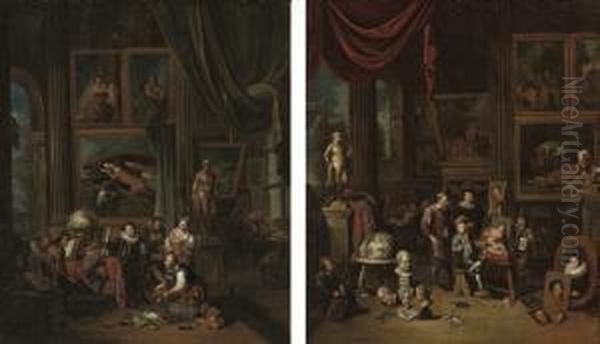
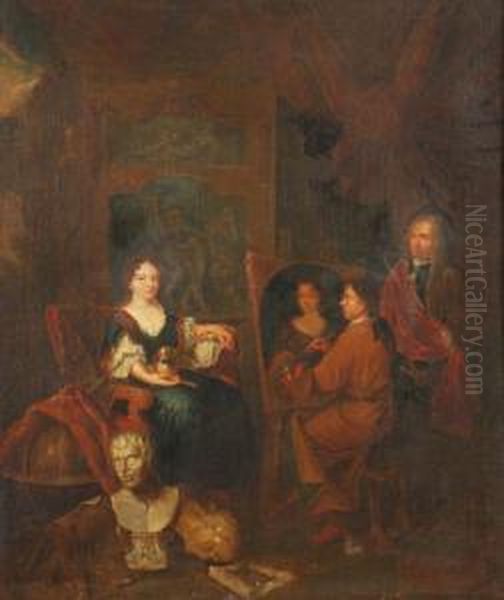
One of Van den Bossche's signature themes was the artist's studio. These paintings offer a romanticized yet informative glimpse into the working environment of a painter in the early 18th century. The studio is often presented as a place of both diligent work and intellectual inspiration. Typically, the artist is shown at his easel, perhaps with pupils or assistants nearby. Models, often elegantly attired, might be posing, or visitors – potential patrons or fellow connoisseurs – might be observing the artist at work or examining finished pieces.
These studio scenes are rich in symbolic content. Plaster casts of classical sculptures, such as busts of Roman emperors or figures from Greek mythology, would signify the artist's grounding in classical tradition and the academic ideal of learning from the antique. Books and globes might allude to the artist's erudition and worldly knowledge. Musical instruments could symbolize harmony, a key artistic principle, or simply the refined pastimes of the cultured class.
Van den Bossche's depictions of studios, such as his various works titled "An Artist's Studio" or "A Painter in His Studio," are not necessarily literal self-portraits or exact representations of his own workspace. Rather, they are idealized constructions that promote the status of the artist as a learned and skilled professional, moving away from the older perception of the painter as a mere craftsman. These works catered to a clientele that appreciated the mystique of artistic creation and the intellectual aura surrounding the arts.
The Picture Gallery: Celebrating Connoisseurship
Equally important in Van den Bossche's oeuvre are his depictions of picture galleries, often titled "A Nobleman's Picture Gallery," "A Collector's Cabinet," or similar. These paintings celebrate the passion for collecting art, which was a significant aspect of elite culture in the 17th and 18th centuries. Such galleries, or "Kunstkammern," were not just displays of wealth but also testaments to the owner's taste, learning, and social standing.
In these scenes, Van den Bossche meticulously renders rooms lavishly adorned with paintings covering the walls from floor to ceiling, often in ornate frames. Sculptures, precious objects, scientific instruments, and curiosities from distant lands might also be present, reflecting the encyclopedic nature of many early modern collections. Groups of elegantly dressed figures – the collector, his family, friends, or art advisors – are shown admiring and discussing the artworks.
These gallery paintings served multiple purposes. For the patron who commissioned such a work, it was a way to document and immortalize their collection, showcasing their cultural capital. For a broader audience, these paintings offered a vicarious experience of viewing magnificent collections and reinforced the cultural value of art. Van den Bossche excelled in capturing the atmosphere of refined connoisseurship that pervaded these spaces. The miniature paintings depicted within these galleries, though not always identifiable as specific works by known masters, often emulated the styles of famous artists or popular genres, adding another layer of appreciation for the knowledgeable viewer. Artists like Jan Brueghel the Elder and Jan van Kessel the Elder had earlier excelled in this genre, often collaborating with figure painters, and Van den Bossche continued this tradition with his own distinct touch.
Notable Works and Their Characteristics
While specific titles and dates for all of Van den Bossche's works can be elusive, several paintings consistently attributed to him exemplify his style and thematic preoccupations.
One prominent example often cited is "An Artist's Studio" (various versions exist). A typical composition might feature the artist, perhaps Van den Bossche himself or an idealized representation, seated before an easel, palette in hand, working on a canvas. Around him, the studio is filled with the accoutrements of his profession: pupils grinding pigments or drawing from casts, shelves laden with books and plaster models, and finished paintings adorning the walls. Often, a well-dressed patron or visitor is present, engaging the artist in conversation or closely examining a piece of art. The atmosphere is one of focused creativity and intellectual exchange.
Another key work, or type of work, is "A Nobleman's Picture Gallery" or "Interior of a Picture Gallery." These paintings transport the viewer into a sumptuously appointed room where walls are densely hung with a multitude of paintings. Figures, presumably the collector and his associates, gesture towards specific works, engage in discussion, or simply contemplate the art. Van den Bossche's skill is evident in his ability to differentiate the numerous small paintings, suggesting various subjects and styles, and in his rendering of the rich furnishings and elegant attire of the figures. These works are a testament to the thriving art market and the culture of collecting in Antwerp and beyond.
In many of these works, the inclusion of musical instruments like lutes, violins, or harpsichords is common. Music was considered a sister art to painting, both governed by principles of harmony and proportion, and its presence added to the overall sense of culture and refinement. The interplay of figures, the careful arrangement of objects, and the harmonious use of colour create compositions that are both visually engaging and intellectually stimulating.
Influences, Contemporaries, and Artistic Context
Balthazar van den Bossche operated within a rich artistic tradition. His primary debt, as mentioned, was to his master, Gerard Thomas, whose thematic interests and stylistic approach provided a direct model. However, Van den Bossche was also part of a broader continuum of Flemish and Dutch art.
The legacy of 17th-century Flemish masters was undeniable. While Peter Paul Rubens (1577-1640), Anthony van Dyck (1599-1641), and Jacob Jordaens (1593-1678) were primarily known for large-scale history paintings, portraits, and religious scenes, their influence on the overall artistic climate, technical standards, and the status of artists in Antwerp was profound. The meticulous realism and vibrant colours characteristic of Flemish art found expression across all genres.
In the specific genre of interior and gallery paintings, Van den Bossche followed in the footsteps of artists like Willem van Haecht (1593–1637), who painted famous depictions of the collection of Cornelis van der Geest, and David Teniers the Younger (1610–1690), who, alongside his peasant scenes, produced numerous paintings of Archduke Leopold Wilhelm's art collection in Brussels. Hieronymus Francken II and Frans Francken the Younger were also pioneers of the gallery painting genre in the early 17th century. Van den Bossche adapted this tradition to the tastes of the early 18th century, often imbuing his scenes with a slightly more Rococo elegance and lightness compared to some of his predecessors.
The influence of Dutch Golden Age painting, particularly genre scenes, is also plausible. Artists like Johannes Vermeer (1632–1675) and Pieter de Hooch (1629–1684) had perfected the art of depicting tranquil domestic interiors with exquisite attention to light and detail. While Van den Bossche's scenes are generally more populated and bustling than Vermeer's contemplative interiors, a shared interest in rendering the textures of everyday objects and the play of light within enclosed spaces can be noted. The work of "fijnschilders" (fine painters) from Leiden, such as Gerrit Dou (1613-1675) and Frans van Mieris the Elder (1635-1681), known for their highly polished technique and minute detail, also contributed to a broader appreciation for meticulously rendered small-scale scenes.
Contemporaries in Antwerp and the wider Netherlands who explored similar themes or whose work shared certain sensibilities might include artists like Gonzales Coques (1614/18–1684), known as the "little Van Dyck" for his elegant small-scale group portraits often set in rich interiors, although he was of an earlier generation. The tradition of flower painting, exemplified by artists like Jan Brueghel the Elder (1568-1625), Daniel Seghers (1590-1661), and later Jan van Huysum (1682-1749), also emphasized meticulous detail and rich textures, qualities valued in Van den Bossche's work. Indeed, some sources suggest Van den Bossche may have been influenced by flower painters like Roelandt Savery (1576-1639) for certain elements or perhaps even for distinct still life compositions, though his fame rests primarily on his populated interiors.
Legacy and Reception
Balthazar van den Bossche's career was cut short by his death in Antwerp on 16 September 1715, at the age of only thirty-four. Despite his relatively brief working life, he achieved considerable success and recognition. His paintings were sought after by collectors, and his influence can be seen in the work of his pupils and followers.
His works are valued today not only for their artistic merit but also as historical documents. They provide a vivid picture of artistic life, studio practices, and the culture of collecting in the early 18th century. The detailed depiction of artworks, musical instruments, scientific tools, and interior décor offers a wealth of information for historians of art, music, science, and material culture.
Paintings by Balthazar van den Bossche can be found in numerous public and private collections across Europe and North America. Museums such as the Hermitage Museum in St. Petersburg, the National Museum in Warsaw, and various regional museums in Belgium and France hold examples of his work. His paintings continue to appear on the art market, where they are appreciated for their charm, elegance, and intricate detail.
Art historical scholarship has acknowledged Van den Bossche's contribution to the genre of interior and gallery paintings. While he may not be as widely known as the towering figures of the 17th century, he holds a respectable place among the Flemish masters of the late Baroque and early Rococo periods. His ability to combine meticulous realism with elegant composition and narrative interest ensures his enduring appeal. The anecdote of a work in a Russian museum undergoing restoration, which revealed his signature and date, underscores the ongoing process of research and attribution that keeps the legacy of artists like Van den Bossche alive and appreciated.
Conclusion
Balthazar van den Bossche stands as a significant Flemish painter whose specialized genre scenes, particularly of artists' studios and picture galleries, capture the essence of early 18th-century artistic and cultural life. Trained in the rich traditions of Antwerp and briefly exposed to the artistic currents of Paris, he developed a distinctive style characterized by meticulous detail, elegant figures, and complex, object-filled compositions. His works celebrate the world of art itself – the process of creation, the joy of connoisseurship, and the status of the artist and patron. Though his life was short, Van den Bossche left a legacy of paintings that continue to fascinate viewers with their intricate beauty and their valuable insights into a bygone era of artistic flourishing. He remains a testament to the enduring vitality of the Antwerp school and a cherished contributor to the genre of interior painting.


