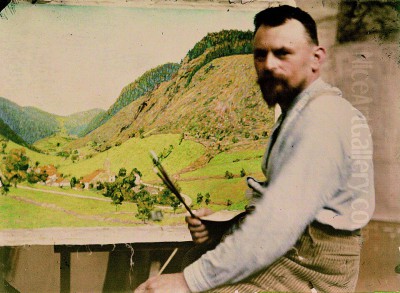
Michel Auguste Colle, a figure who navigated the vibrant and rapidly evolving art world of late 19th and early 20th century France, remains an intriguing, if somewhat understated, painter. Born in 1872 and passing away in 1949, Colle's life spanned a period of immense artistic innovation, from the afterglow of Impressionism to the rise of modernism. While not achieving the household-name status of some of his contemporaries, his dedication to his craft, particularly in landscape painting, offers a valuable glimpse into the artistic currents of his time.
His journey as an artist appears to have been one of personal dedication rather than formal academic training, marking him as a largely self-taught talent. This path, while not uncommon, often imbues an artist's work with a unique perspective, free from the rigid constraints of established art academies, allowing for a more personal exploration of style and subject matter.
Early Career and Parisian Debut
The year 1903 marked a significant milestone for Michel Auguste Colle, as he began to regularly exhibit his works at the prestigious Paris Salon. The Salon, for decades, was the paramount venue for artists to gain recognition, attract patrons, and establish their careers in the competitive Parisian art scene. To be accepted into the Salon was an achievement in itself, indicating a certain level of skill and adherence to, or at least an acceptable deviation from, prevailing artistic standards.
Further cementing his professional standing, Colle entered into an exclusive contract with Émile Corne, a notable art dealer based in Naples. This arrangement, which spanned from 1903 to 1911, would have provided Colle with a degree of financial stability and a dedicated channel for the sale and promotion of his artworks. Such dealer contracts were becoming increasingly important for artists, offering an alternative to the Salon system or a complementary path to success.
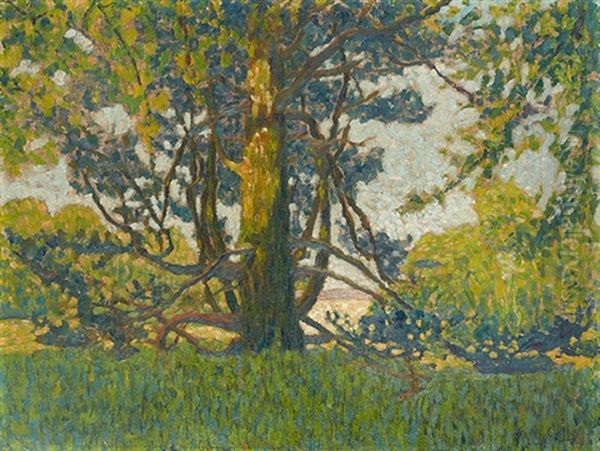
Colle's early oeuvre was characterized by a focus on the landscapes of the Lorraine region in northeastern France. This area, with its distinctive natural beauty, rolling hills, forests, and waterways, provided ample inspiration. His depictions of Lorraine were rendered in a style that bore the clear hallmarks of Impressionism, a movement that had revolutionized painting in the preceding decades.
Impressionistic Sensibilities
The Impressionist movement, which had its revolutionary heyday in the 1870s and 1880s with artists like Claude Monet, Camille Pissarro, and Alfred Sisley, continued to exert a powerful influence well into the 20th century. Its emphasis on capturing the fleeting effects of light and atmosphere, a commitment to painting en plein air (outdoors), and the use of broken brushwork and a vibrant palette resonated with many artists, including Colle.
His Lorraine landscapes likely showcased these characteristics: an attentiveness to the changing seasons, the quality of light at different times of day, and the natural colors of the environment. The "impression" of a scene, rather than a meticulously detailed academic rendering, was paramount. This approach allowed for a more subjective and immediate response to the natural world, imbuing the canvases with a sense of vitality and freshness.
While the first wave of Impressionists had faced considerable critical resistance, by the time Colle was establishing his career, Impressionism had gained wider acceptance and had even begun to be seen as a foundational modern movement. Artists like Colle were, in a sense, inheritors of this legacy, adapting its principles to their own visions. He was working at a time when Post-Impressionist figures like Paul Cézanne, Vincent van Gogh, and Paul Gauguin had already made their radical departures, pushing the boundaries of color, form, and emotional expression even further.
Representative Works and Thematic Focus
Among the works attributed to Michel Auguste Colle, several titles give us an insight into his thematic preoccupations. "Vue d'Alger" (View of Algiers) suggests a departure from his familiar Lorraine scenery and an engagement with the Orientalist themes that had fascinated French artists since the early 19th century, notably Eugène Delacroix. This oil painting, measuring 50 x 76 cm, would have offered Colle an opportunity to explore the brilliant light and exotic atmosphere of North Africa, a subject that allowed for a different palette and compositional challenges compared to the more temperate European landscapes. The allure of Algiers and other North African locales had drawn many artists, and Colle's interpretation would have added to this rich visual tradition.
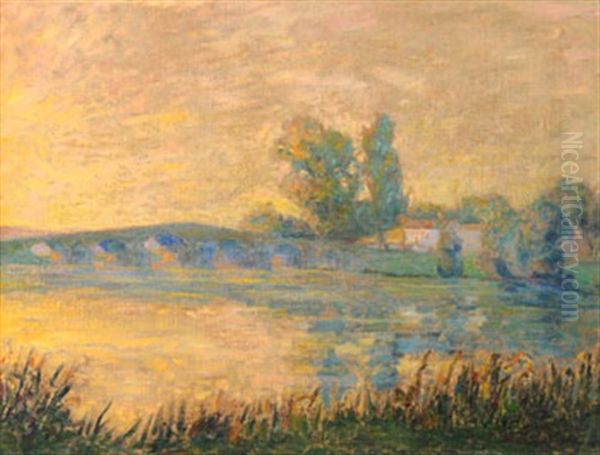
Another significant work is "Paysage de Gorze" (Gorze Landscape). Gorze, a commune in the Lorraine region, is known for its historical abbey and picturesque surroundings. This painting, also an oil work, would likely reflect his continued engagement with the landscapes of his native or adopted region, capturing its specific character and beauty. The choice of Gorze as a subject indicates a deep connection to place, a common trait among landscape painters who find endless inspiration in their immediate environment.
Titles such as "Sous bois" (Undergrowth or In the Woods) and simply "Paysage" (Landscape) further underscore his commitment to landscape painting. "Sous bois" often implies an intimate, enclosed scene, perhaps focusing on the interplay of light filtering through trees, the textures of bark and foliage, and the quiet solitude of the forest interior. Such subjects were popular among Impressionist and Barbizon School painters like Théodore Rousseau before them, who sought to capture the unadulterated beauty of nature.
The dimensions and medium (oil on canvas) of these works are typical for Salon exhibitions and for painters aiming to create substantial, impactful pieces. The use of oil paint allowed for rich color, textural variety, and the layering techniques often employed to convey depth and luminosity, all central to the Impressionist endeavor.
The Artistic Milieu of Paris
Michel Auguste Colle was active during a period when Paris was undeniably the art capital of the world. The city buzzed with artistic debate, new movements, and a plethora of galleries and exhibition societies beyond the official Salon. While Colle's style was rooted in Impressionism, he would have been aware of the seismic shifts occurring around him.
Fauvism, led by Henri Matisse and André Derain, had exploded onto the scene in 1905 with its shockingly bold, non-naturalistic colors. Shortly thereafter, Cubism, pioneered by Pablo Picasso and Georges Braque, began to deconstruct form and challenge traditional perspectives. These avant-garde movements were redefining the very nature of art.
It is not clear from the available information to what extent Colle engaged with these radical new styles, or if he maintained a more conservative, though still modern, Impressionistic approach. Many artists of his generation found themselves at a crossroads, either embracing the new "-isms" or continuing to explore the possibilities within established modern traditions like Impressionism and Post-Impressionism. Painters such as Pierre Bonnard and Édouard Vuillard, associated with the Nabis group, found their own lyrical paths, often focusing on intimate interior scenes and decorative qualities, drawing from Impressionist color but with a different sensibility.
The Paris Salon itself was evolving. While still a major institution, its dominance was challenged by alternative venues like the Salon des Indépendants and the Salon d'Automne, which were more receptive to experimental art. Colle's regular participation in the Paris Salon suggests he found a receptive audience there for his landscape work.
Interactions and Influences
Details regarding Michel Auguste Colle's direct interactions with other prominent painters of his era are not extensively documented in the readily available sources. The art world of Paris, however, was a relatively close-knit community, especially within specific stylistic circles. It is plausible that he would have known or been acquainted with other landscape painters exhibiting at the Salon or frequenting the same artistic cafés and circles.
His artistic style, being distinctly Impressionistic in its early phase, clearly shows the influence of the pioneering Impressionists. The emphasis on light, color, and capturing a momentary sensation connects him directly to the innovations of Monet, Pissarro, and Sisley. Whether he was directly taught by any Impressionist figures or absorbed their influence through exhibitions and the general artistic climate is not specified, but the impact is undeniable.
One might also consider the broader context of landscape painting in France. The Barbizon School, which predated Impressionism, had already established a tradition of direct observation of nature. Artists like Jean-Baptiste-Camille Corot had paved the way for a more naturalistic and poetic approach to landscape, which in turn influenced the Impressionists. Colle's work can be seen as part of this continuing lineage of French landscape art.
The mention of "Sous bois" potentially being influenced by Dutch Golden Age painting due to its size and oil technique is an interesting point of speculation. While Dutch masters like Jacob van Ruisdael or Meindert Hobbema were renowned for their detailed and atmospheric forest scenes, a direct line of influence would require more specific stylistic analysis of Colle's work. However, the rich tradition of European landscape painting was certainly part of the visual vocabulary available to any artist of Colle's time.
Exhibitions, Recognition, and Later Career
Beyond his regular participation in the Paris Salon from 1903 onwards, specific details about other major exhibitions or critical reception of Michel Auguste Colle's work are sparse. The Salon itself was a diverse venue, showcasing a wide range of styles and artists, from the academic to the moderately modern. Colle's consistent presence there suggests a sustained level of production and acceptance within that system.
The exclusive contract with the dealer Émile Corne from 1903 to 1911 indicates a period of professional activity and market presence. Such contracts often involved commitments to produce a certain number of works and could lead to wider exposure through the dealer's network, potentially including clients outside of Paris or even internationally.
Information about Colle's artistic development after this initial period is not extensively detailed in the provided summaries. Whether his style evolved, perhaps absorbing elements of Post-Impressionism or other contemporary movements, or whether he remained dedicated to his Impressionistic roots, is a subject for further art historical research. Many artists of his generation continued to work in an Impressionist or Post-Impressionist vein well into the 20th century, finding new ways to explore its potential even as more radical styles emerged.
The current locations of his key works, such as "Vue d'Alger" and "Paysage de Gorze," are not definitively stated as being in major public museum collections based on the initial information. Many works by artists who were successful in their time but did not achieve superstar status often reside in private collections or regional museums. Auction records indicate that his paintings, such as "Sous bois" and "Paysage," continue to appear on the art market, allowing new generations of collectors and enthusiasts to encounter his work.
Legacy and Conclusion
Michel Auguste Colle represents a significant cohort of artists who, while perhaps not radically altering the course of art history in the manner of a Picasso or Matisse, contributed to the rich tapestry of artistic production in their time. His dedication to landscape painting, rendered in an Impressionistic style, speaks to a deep appreciation for the natural world and a commitment to capturing its ephemeral beauty.
His early success in exhibiting at the Paris Salon and securing a dealer contract points to a recognized talent. His choice of subjects, from the familiar landscapes of Lorraine to the more exotic "Vue d'Alger," shows an artist willing to explore different environments and the challenges they presented.
In the grand narrative of art history, which often focuses on the most revolutionary figures, artists like Michel Auguste Colle play a vital role. They demonstrate the breadth and depth of artistic movements, showing how influential styles like Impressionism were adopted and adapted by a subsequent generation. They also remind us that the art world is composed of many voices, each contributing to the cultural landscape.
While further research would be needed to fully elucidate the nuances of his career, his interactions, and the evolution of his style, Michel Auguste Colle stands as a testament to the enduring appeal of Impressionist landscape painting and the dedicated artists who pursued its expressive possibilities throughout their lives. His work offers a window into the artistic sensibilities of the early 20th century, a period of profound change and enduring beauty in the world of art. His paintings, when they surface, continue to speak of a quiet dedication to capturing the light and atmosphere of the world around him.


