Auguste Roubille Paintings
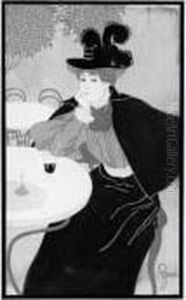
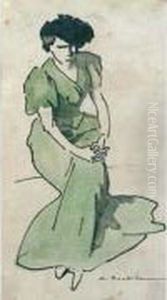
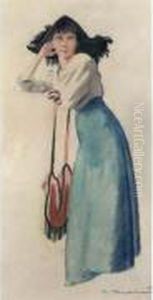
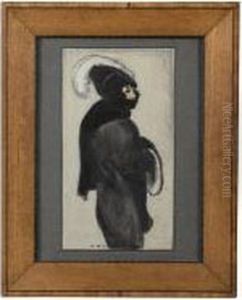
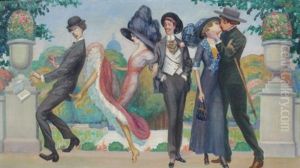
Auguste Roubille was a prominent French artist and illustrator, whose career spanned the late 19th and early 20th centuries. Born in 1872, Roubille was recognized for his distinctive style, which skillfully blended elements of Art Nouveau with a keen observational humor, making his works both aesthetically pleasing and intellectually engaging. He was especially adept at capturing the essence of Parisian life during the Belle Époque, a period marked by cultural flourishing and artistic innovation in France.
Roubille's artistic journey began at a young age, showing early promise that led him to study at the prestigious École des Beaux-Arts in Paris. His education and natural talent equipped him with the skills to explore various mediums, including illustration, poster design, and advertising, which were burgeoning fields at the turn of the century. He quickly made a name for himself in the bustling Parisian art scene, contributing to magazines, designing posters for theaters and exhibitions, and working on advertising campaigns for a range of products.
His work was characterized by a dynamic use of line and color, which brought life to his subjects and charmed the Parisian public. Roubille's illustrations often featured satirical depictions of contemporary society, politics, and the foibles of the bourgeoisie, making them popular among a wide audience. His ability to capture the mood and spirit of the era, with a mix of humor and social commentary, made his work highly sought after by publishers and commercial enterprises alike.
Despite his success, Roubille remained dedicated to evolving his artistic style, experimenting with new techniques and mediums throughout his career. He was also a part of the vibrant artistic community in Paris, interacting with other artists, writers, and intellectuals who were at the forefront of the avant-garde movements of the time.
Auguste Roubille's legacy is that of a versatile and innovative artist who contributed significantly to the visual culture of his time. His works continue to be celebrated for their artistic merit and historical significance, offering insights into the social and cultural dynamics of early 20th-century Paris. Roubille passed away in 1955, leaving behind a body of work that continues to inspire and entertain audiences around the world.
Copyright 2010 - 2026 by PlentyOfPaintings.com All rights reserved. - Your Paintings of Choice


