Claude Flight Paintings
Claude Flight was a British artist and a leading proponent of the linocut technique, which became popular among modern artists in the early 20th century. Born in London in 1881, Flight was initially trained as an architect, but he soon turned his attention to art. He was particularly interested in the Futurist and Cubist movements, which influenced his work significantly.
Flight served in World War I, and his experiences during the war had a profound impact on him. After the war, he focused on his art career and became a key figure in the Grosvenor School of Modern Art in London, where he taught linocutting from 1926 onwards. He was passionate about making art accessible to the masses and believed that linoleum block printing was a democratic medium because it was inexpensive and could be practiced by anyone.
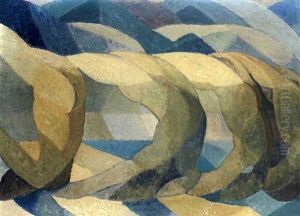
Throughout the 1920s and 1930s, Flight's work was exhibited widely, and he wrote several influential books on linocutting, including 'Lino-Cuts: A Hand-Book of Linoleum-Cut Colour Printing.' His style was characterized by dynamic compositions, bold color schemes, and a sense of rhythm and movement, which reflected contemporary interest in speed and technology.
Flight's influence extended beyond his own practice as he was instrumental in promoting the work of his students and other linocut artists. He organized exhibitions and wrote extensively on the subject, helping to establish linocutting as a respected artistic technique.
Unfortunately, the outbreak of World War II and the subsequent changes in artistic tastes led to a decline in the popularity of linocuts. However, Claude Flight's contribution to the art form was significant, and he remained an active artist until his death in 1955. Today, his works are recognized for their vibrant energy and are held in numerous public and private collections worldwide. Flight's legacy continues to inspire artists and printmakers, and his teachings on linocut as an accessible and expressive medium are still relevant.
Copyright 2010 - 2026 by PlentyOfPaintings.com All rights reserved. - Your Paintings of Choice


